itch.io vs Steam for Your First Indie Game
itch.io is free to publish on and suits free builds, demos and jam games. Steam costs a one-time fee per game. Here is how they compare for a first release.
By Mark Fulton ·
Last verified:
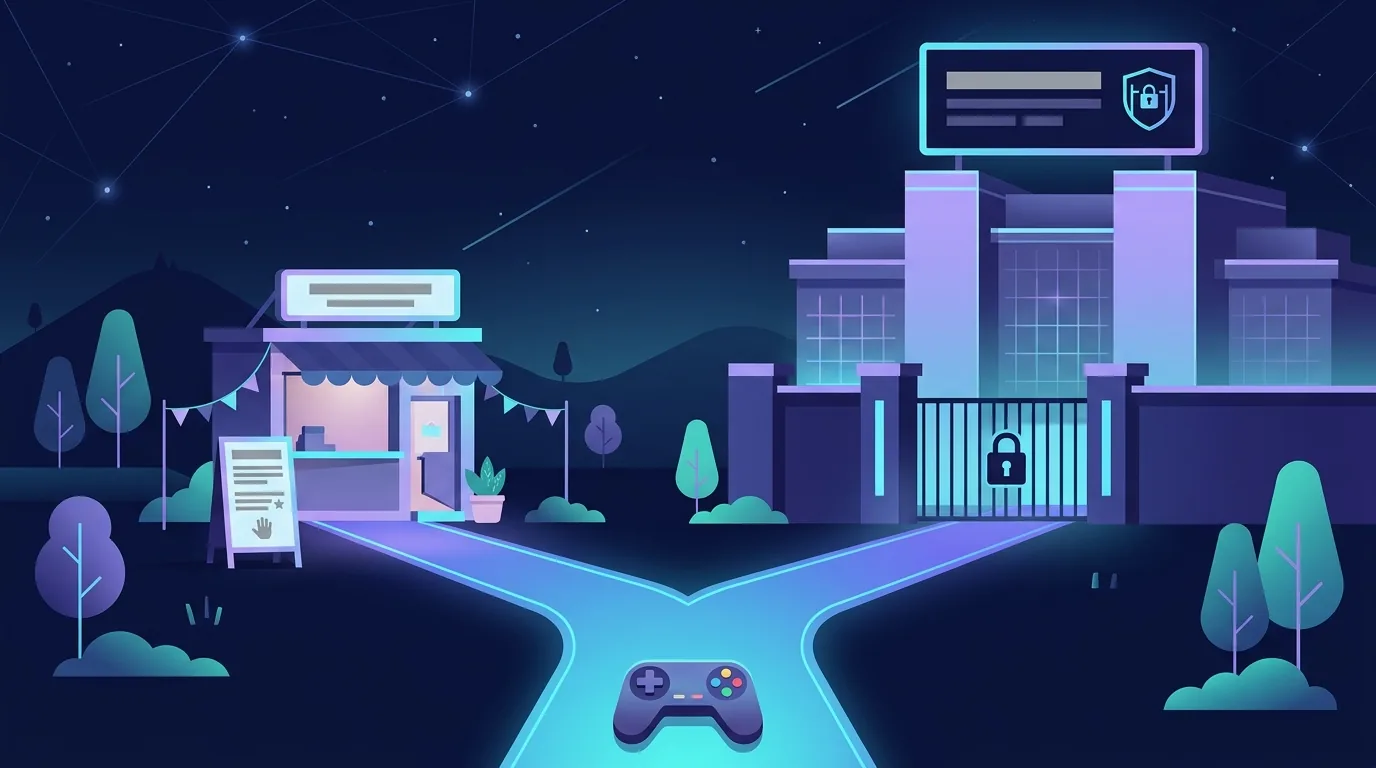
For a first indie game, start on itch.io. Creating a project costs nothing, you can set the game to free, pay-what-you-want or a plain download, and you can put up a rough build or a jam entry the same day. Steam charges a one-time Steam Direct fee for each new game and is built around a polished store page, so it fits a finished, priced game better than a first experiment. You can use both: itch.io for builds, demos and early feedback, Steam when the game is ready to be sold.
Most comparisons of these two stores are written for developers with a paid game and a launch plan, and they spend their time on revenue share. If your first game is free, a demo or a game jam entry, the revenue split is close to irrelevant. What matters is what it costs to get a page live, who can find you, how you hear from players, and whether choosing one now closes a door later. This guide answers those questions one at a time.
What does each platform cost to put a game on?
On itch.io, you sign up for a free account, open your dashboard and create a new game. According to itch.io's getting started guide, you add a title, short description, cover image and three to five screenshots, choose a category, upload files and pick a genre and up to ten tags. New pages are private until you switch them to public, so you can preview first. The guide lists no platform fee for creating a page.
Money only enters if you charge for the game. itch.io uses what its payments documentation calls open revenue sharing: you choose what share of each sale goes to itch.io. The default in its example is 10%, and you can set it anywhere from 0% to 100%. Payment processor fees still apply to paid sales, and the Payouts system carries a one-time tax verification fee that the docs put at $3.00, taken from your balance later. None of that applies if the game is free.
On Steam, you pay a Steam Direct fee for each new game you distribute. The Steamworks documentation page for it describes a $100 USD fee per new app, and Valve's own fee listing says the fee is recoupable once the game reaches at least $1,000 in adjusted gross revenue. Steam also takes a share of sales, which Valve states in its partner documentation; check the current figure there before you plan around it, because it has tiers and can change. A free game pays no sales share because it has no sales, but the per-game fee still applies to the store page.
For a first project, the practical difference is this: on itch.io, the cost of being wrong is an afternoon. On Steam, it is a fee and a store page you have to keep up.
How do players find games on each?
The two stores work in opposite ways, and it changes what you should expect.
itch.io is a browse-and-tag marketplace. Players find games through tags, genres, jam pages, collections and search. Accurate metadata decides whether you show up: the itch.io quality guidelines say pages that follow the rules can be indexed for browse, search and recommendations, and that pages that do not can be removed from those listings while staying reachable by direct link. Wrong tags or missing details cost you the right audience. The same guidelines note that a new public page appears on the Most Recent list straight away, but that is a short window, not a launch plan.
Steam is a store with a large built-in audience, and visibility is earned. Your page competes with every other release, and people who find games there are used to polished capsule art, trailers and reviews. A page with one screenshot and no trailer looks unfinished next to them. Steam rewards preparation before release, such as a store page that exists early enough to collect wishlists, which is why it suits a game you have planned for rather than one you made over a weekend.
Neither store sends traffic on its own to a game nobody has heard of. On both, the first players come from you: a jam, a genre community, a few small creators. The first-fifty-players tactics in how to get people to play your indie game apply to either store.
Which one suits a free game or a demo?
itch.io, by a wide margin, and the reason is in the pricing options. The itch.io pricing documentation lists four: pay what you want with a minimum price, "$0 or Donate" (players are asked for a donation but can skip it and download anyway), a fixed paid price, and "No payments," where payments are disabled and every file is freely downloadable. A free game fits "No payments" or "$0 or Donate" without any workarounds. HTML5 builds can also be embedded so people play in the browser with no download, which is the lowest friction a stranger will ever see.
Steam can host free games and demos too, but you are paying for a store presence that is designed to sell, and a demo there is a promotion for a game you are also releasing. If you do not yet have that game, a demo has nowhere to point.
Game jam entries belong on itch.io for a simpler reason: the jams run there. A jam is a deadline, a crowd of other developers and a page that exists for the length of the event.
How does feedback reach you on each?
This is the part first-time developers underrate. A first game is mostly a way to learn, and what you learn depends on how easily players can talk to you.
| itch.io | Steam | |
|---|---|---|
| Comments on the game page | Yes, on the project page | Reviews and discussion forum, mostly from owners |
| Who can reply easily | Anyone with an account, including people who skipped payment | Mostly players who own the game or its demo |
| Updates to followers | Public updates reach followers' feeds; the Interact tab lets you email buyers about major releases | Announcements to people who own or wishlist the game |
| Typical feedback tone | Informal, often from other developers and jam players | Review-driven, with ratings that shape how the page looks |
| Cost of a bad first impression | A rough comment you can answer and fix | A visible review score on a paid page |
The practical point is the last row. On itch.io, early rough feedback is part of the culture. On Steam, early reviews become the public face of the game. If you want to hear "I got stuck in the second room" without it being a permanent mark on your page, an itch.io page is a safer place to hear it.
Whichever store you use, ask each player the same two or three questions and write the answers in one place. That habit is worth more than the platform choice.
Can you start on itch.io and move to Steam?
Yes, and for many developers this is the sensible order. There is no rule that a game on itch.io cannot also be on Steam, and the two storefronts are independent accounts. A common path looks like this:
- Release a small build or jam game on itch.io and collect comments.
- Fix what players tell you, posting updates so people see the game improve.
- Decide whether the game deserves a store page. If players finish it and ask for more, it might.
- Open a Steam page for the larger version, and keep the itch.io page as the home for the free demo or early builds.
Two cautions. First, a build you keep on both stores should be the same game, with the same name, so players are not confused about which is current. Second, if you sell on both, check each store's current terms about pricing and keys before you set up the second one, because those policies change and the platform documents are the authority. What you cannot do later is take back a poor first impression, which is one more reason to test the rough version where the stakes are low.
When does Steam become the right call?
Move to Steam when most of these are true:
- The game is finished enough to describe in one line that makes a stranger curious, and you have tested that line on people who have not seen it.
- You intend to charge for it, and the game has enough content to justify a price.
- You can produce a store page with screenshots, a short trailer and a clear description, and you are ready to answer reviews.
- You have players already, even a small group, who will wishlist or recommend it.
- You are ready to treat it as a business, including the one-time fee, tax paperwork and ongoing support.
If three or four of these are true, Steam is worth the fee. If none are, the cheapest next step is another build on itch.io.
Which platform should you pick? A first-game comparison
| Question | itch.io | Steam |
|---|---|---|
| Upfront fee | None to create a project; a one-time tax verification fee applies if you use Payouts | One-time Steam Direct fee per game ($100 USD per Steamworks documentation), recoupable at $1,000 adjusted gross revenue |
| Revenue share | You set it, 0% to 100%, default example 10% | Set by Valve; check the current rate in Steamworks |
| Free options | "$0 or Donate" and "No payments" | Free games possible, but the per-game fee still applies |
| Pay what you want | Yes, with a minimum price | Check Steamworks; not a documented focus here |
| Browser play | HTML5 embeds supported | Not covered here; check Steamworks |
| Discovery | Tags, genres, jams, collections | Store search, wishlists and recommendations built on page quality |
| Feedback | Open comments and follower updates | Owner reviews and forum threads |
| Moving later | Easy to keep running next to Steam | Can host a paid version while itch.io keeps demos |
| Best for | Free builds, demos, jam games, early tests | A finished, priced game with a prepared store page |
What about listing the game somewhere else too?
Neither store is a showcase for people who want to try something right now without browsing a marketplace. TryMy has a game category for free, demo and freemium games, and a listing there is a one-time $19 placement. It is one more place a player can land on, not a replacement for either store. If you are still deciding where to post, where to submit your app for free lists the platforms worth an hour.
Frequently asked questions
Is itch.io free for developers?
Creating an account and a project page costs nothing. According to itch.io's documentation, you choose how much of each sale goes to itch.io, from 0% to 100%, and payment processor fees apply to paid sales. If you use the Payouts system, a one-time $3.00 tax verification fee is taken from your balance later. A free game carries none of the sales costs.
How much does it cost to publish on Steam?
Steam charges a one-time Steam Direct fee for each new game. The Steamworks documentation describes it as $100 USD per app, and Valve's fee listing says it can be recouped once the game reaches at least $1,000 in adjusted gross revenue. Check the Steamworks page for the current figure before you pay, since fees and terms can change.
Can a game be on itch.io and Steam at the same time?
Yes. They are separate storefronts with separate accounts, and many developers keep a free demo or early builds on itch.io while the full game is sold on Steam. Keep the game name and version consistent across both, and read each store's current terms on pricing before you list a paid version on both.
Do free games do well on Steam?
There is no verified figure to quote here, and results vary widely by genre and by how many players you bring yourself. A free game on Steam still needs the paid-for store page and the marketing work, with no sales to cover the fee. For a first free game, itch.io usually gives you more feedback for less effort, and you can add Steam later if the game grows.
Put your game in front of players
Free, demo or freemium game? Add it to the TryMy game category for a one-time $19, human-reviewed before it goes live.