Product Hunt Launch Day: Hour-by-Hour Runbook
A solo maker's Product Hunt launch day plan, hour by hour from T-12 to T+24: what to queue in advance, when to post, how to handle comments, what to skip.
By Mark Fulton ·
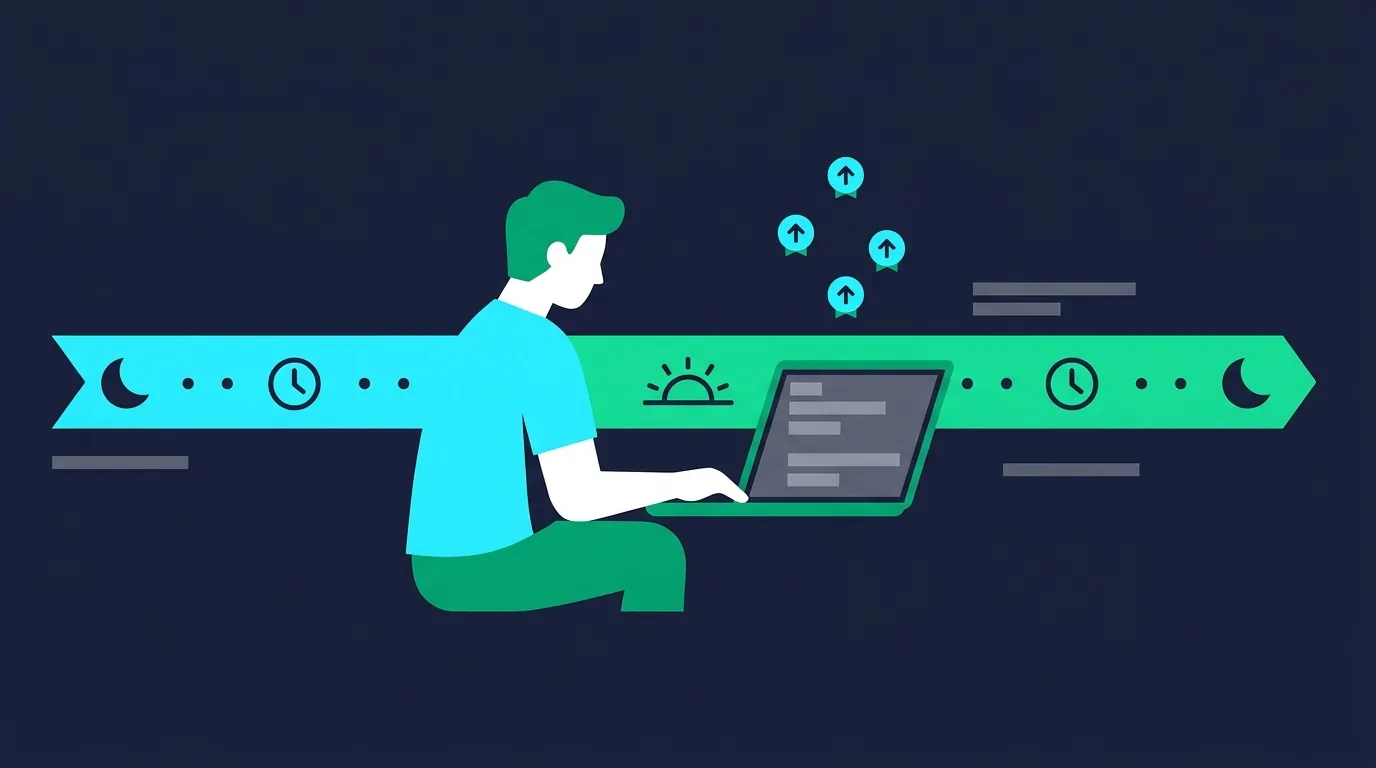
On Product Hunt launch day you do four things, and none of them is refreshing the leaderboard. You schedule the launch in advance so it goes live at 12:01am Pacific without you being awake for it. You post your first comment as the maker, which is the single highest-leverage fifteen minutes of the day. You tell the people who already know you that the thing is live, asking them to look and comment rather than to upvote, because asking for upvotes is against Product Hunt's rules and can cost you the ranking you were chasing. Then you answer every comment on the page, in batches, around whatever else your day already contains. That is the job. Everything else is optional.
Most launch guides are written for a team. They assume somebody is on comments while somebody else is on Twitter, that a Slack channel is coordinating the day, and that a thirty-day audience warm-up already happened. If you are one person with a day job, that plan does not survive contact with 9am. This is the same day rewritten for one set of hands, with a timetable you can print. It pairs with our launch day checklist for solo developers, which covers the week before. This page is the day itself.
The runbook
Times are Pacific, because Product Hunt's homepage runs on a Pacific clock. Work out the offset to where you live once, write it on the table, and stop doing the mental arithmetic at 2am.
| Time (Pacific) | The one thing you do |
|---|---|
| T-12h (noon, day before) | Final pass on the listing: tagline, gallery, links. Then stop editing. |
| T-6h (6pm, day before) | Write and save your maker first comment somewhere you can paste from. |
| T-2h (10pm, day before) | Queue the announcement posts. Do not send them yet. |
| T-1h (11pm, day before) | Send the heads-up message to your close list. Then go to bed. |
| T-0 (12:01am) | Nothing. The scheduled launch goes live on its own. |
| T+1h (1am) | Still nothing. You are asleep. This is the plan working. |
| T+6h (6am) | Wake up. Post the first comment. Read the page before you react to it. |
| T+7h (7am) | Publish the queued announcements. Reply to every comment that exists. |
| T+9h (9am) | Day job starts. Set one alarm for a midday comment sweep. |
| T+12h (noon) | Twenty minutes: clear the comment backlog, fix anything broken people found. |
| T+16h (4pm) | Second sweep. Reply to newcomers, thank the people who showed up early. |
| T+20h (8pm) | Last sweep. Write down what actually happened, honestly. |
| T+24h (midnight) | The homepage rolls over. Close the tab. Tomorrow is the useful part. |
What has to be done before the clock starts?
Three things, and only three, have to be finished before 12:01am Pacific.
The launch has to be scheduled. Product Hunt's help centre describes picking a day "within 30 days of your current day for the post to go live" in its guide to scheduling a post. Scheduling is the difference between a solo launch and a bad night. A launch that fires on its own at 12:01am Pacific does not need you conscious in a European or Asian time zone. If you are in the Pacific time zone yourself, you still schedule it, because being awake at midnight buys you nothing and costs you the morning.
The first comment has to be written. Product Hunt's own preparation guide reports that "70% of products who achieved Product of the Day, Week, or Month had a first comment by the maker." That is the highest ratio of outcome to effort available anywhere in this process. Write it the night before, when you are calm, not at 6am when you are looking at a number you did not expect. Say what the thing is, why you built it, what it does not do yet, and one specific question you want answered. The question is what turns a comment section into a conversation instead of a queue of congratulations.
The announcements have to be drafted and queued. Not sent. Drafted, in whatever tool you use, so that publishing them at 7am is a single click rather than twenty minutes of writing while the page is live and your attention is gone.
Anything else is preparation, and preparation belongs to the week before. If you are still deciding your launch date, the best day to launch on Product Hunt is a trade rather than a fact, and it is worth two minutes of thought before you schedule.
What happens in the first hour?
Nothing you can influence, which is the part nobody tells solo makers.
The first hour of a Product Hunt day starts at 12:01am Pacific. If you live anywhere east of Denver, that hour happens while you are asleep, and this is fine. The scheduled launch goes live. Some early browsers see it. Your number moves or it does not. There is no action available to you in that window that beats being rested for the sixteen hours that follow.
The reason team-written guides put so much weight on the first hour is that a team can staff it. Someone in Berlin is awake at 9am local, which is midnight Pacific, and they can be first in the comments. You do not have a person in Berlin. Trying to be your own person in Berlin means you are wrecked by the time the audience you actually have wakes up, which is a worse trade than starting slowly.
So the honest version of the first hour for a solo maker is: it belongs to the platform. Yours starts when you wake up.
When should you post to your own channels?
At 6 to 7am Pacific, after your first comment is up, and in one pass rather than throughout the day.
Post the announcements you queued. Send the personal messages to the twenty or thirty people who have actually used your product and said something nice about it. Those messages should not go out at 11pm the night before as a surprise, and they should not go out at 4pm when the day is nearly over. They go out once, in the morning, pointing at a page that already has a maker comment on it so the first thing a visitor reads is you explaining the thing rather than an empty thread.
The wording matters more than the timing. Product Hunt's community guidelines state that "mass messaging users, asking for upvotes, using bots, incentivizing upvotes, and any other form of artificially increasing activity on your contribution is not acceptable." Their help centre is blunter still in the article on asking friends and family to upvote: "Please don't. People should upvote things they genuinely like or find interesting, not because they were peer pressured to do so." The same article warns that asking or incentivizing people to upvote "may trigger the algorithm to drop the product in the ranks or remove it from the homepage entirely."
The workable version is the one Product Hunt's own launch guide endorses: "you cannot ask people directly to upvote your product. Instead, ask them to visit and comment." So write "we are live on Product Hunt today, I would love your read on it" and link the page. People who like it will do the thing you were not allowed to ask for. People who do not will leave you a comment that is worth more than a vote anyway.
This also rules out the services that sell upvote packages. Product Hunt says it removes votes "deemed non-genuine or contrary to community guidelines" and that algorithms monitor unusual voting patterns. Buying votes puts your launch in front of that system on purpose. It is a bad bet with your own product as the stake.
How do you handle comments while doing your day job?
In three scheduled sweeps, not continuously.
Continuous monitoring is what every team-oriented guide recommends, usually as a thirty-minute response target, and it is exactly the advice that breaks a solo launch. You cannot hold a support desk open while doing paid work, and trying to means you do both badly and spend the day anxious.
Instead, put three twenty-minute blocks in your calendar: around 7am, around noon, around 4pm Pacific, adjusted to whatever your day allows. In each block you clear the entire backlog. Reply to every comment, including the one-word ones, because a maker who answers everybody reads very differently from a maker who answers the interesting questions.
Two rules make the sweeps work. First, answer the question that was asked, not the question you wish had been asked. If someone says the onboarding confused them, do not explain why it is designed that way. Say you will fix it, and if it is a five-minute fix, fix it during the sweep and reply saying it is done. That single move converts more sceptics than any amount of enthusiasm. Second, keep a scratch file open all day and paste every piece of feedback into it. You will not remember any of it on Thursday.
Between sweeps, close the tab. Genuinely. The number does not move faster when you watch it, and the cost of checking is that you spend the day in a state where you cannot do anything else either.
If you get to launch morning and realise nobody is coming, that is not a launch day problem. It is a problem from four weeks ago, and the fix is the slow one: getting your first 100 people to try your app before you need them. Communities where makers help each other test and show up for launches, like Favors.dev, are a more honest source of early attention than any list you can buy, because the people there have used something of yours in return.
What do you do the day after?
You keep answering, and you move the traffic somewhere permanent.
Product Hunt's guidance for the days after your launch is to keep "monitoring your launch page for new comments, and continue to respond just as you did on launch day," and to follow up with people who used the product. It also draws a distinction worth internalising: the launch page is temporary and promotable for about two weeks, while the product page is "your permanent and comprehensive source of truth."
That distinction is the whole reason launch day disappoints people. The launch page is a spike. The day after, the spike is over, and whatever you built to catch it is what you keep. So the day after is for three things. Email or reply to everyone who signed up, individually, while your launch is still a reason to be in their inbox. Fix the top two things people complained about, and say publicly that you fixed them. And put your app somewhere that is still working next month, which is the argument for listings and directories generally and for where to post your app in 2026 specifically.
What can you safely skip as a solo maker?
More than you think.
A hunter. Product Hunt's launch guide says plainly: "We encourage makers to hunt their own products, and there's no discernible advantage to using a third-party hunter." Its preparation guide adds that "79% of featured posts were by makers who self-hunted" and "60% of #1 Product of the Day winners were self-hunted." Skip the week of DM outreach to strangers with big follower counts.
Being awake at midnight. Covered above. Schedule it.
Paid promotion of the launch. Buying traffic to a page whose value is a ranking you cannot buy is a strange use of money on a day when you have not yet learned anything about your product.
A launch video, if you do not already have one. It correlates with good outcomes, but it is an afternoon of work you cannot do on launch day. Note it for the relaunch.
Simultaneous launches everywhere. One person cannot hold three comment sections open. Pick Product Hunt or pick somewhere else. If Product Hunt is the wrong room for what you built, there are Product Hunt alternatives sorted by which kind of app they suit, and going deep on one of them beats going shallow on four.
Frequently asked questions
Do I need a hunter?
No. Product Hunt states there is "no discernible advantage to using a third-party hunter" and encourages makers to hunt their own products, and its own figures show most featured posts and most Product of the Day winners were self-hunted. Hunters were a meaningful lever years ago. The idea that you need one has outlived the mechanic.
Should I ask people directly for upvotes?
No, and this is a rule rather than a preference. Product Hunt's community guidelines list "asking for upvotes" alongside bots and incentivized votes as unacceptable, and its help centre warns that doing so may drop your product in the rankings or remove it from the homepage. Ask people to visit and comment. That is explicitly allowed, and it produces better outcomes anyway, because a page with a real conversation on it converts strangers and a page with a big number does not.
What if I get almost no votes in the first hour?
Then you had a quiet first hour, which is the normal experience for a maker without an audience in a Pacific time zone. It is not a verdict. The useful response is to carry on with the plan: post your first comment, tell your people, answer everything. The launches that go badly are not the ones that start slowly, they are the ones where the maker gets discouraged at 7am and stops showing up in their own comment section.
Is it worth launching without an email list?
It is worth it for feedback and for the permanent product page. It is usually not worth it for the ranking. Without a list, you are competing on a leaderboard against products that have one, and no amount of launch day effort closes that gap in twenty-four hours. Launch anyway if you want strangers to look at your work and tell you what is wrong with it. Just set the expectation honestly, and spend the following month building the list so the relaunch has somewhere to start from.
The day ends. At midnight Pacific the homepage rolls over, your launch page starts its slow slide, and whatever you built to catch the traffic is all you keep. That is the argument for having a listing up before launch week rather than after it. Submit your app to TryMy free, a human reads it before it goes live, and it sits in a browsable showcase of things people can actually try. We only list apps someone can try without paying, which is the whole point. There is a featured spot if you want the top of the grid, and we will say the quiet part again: it is a position and a badge, not a traffic guarantee. The free listing is the part that matters, and it takes ten minutes once.